Groups
Groups are hierarchical containers that organize Resources, Notes, and other Groups. Each Group can own entities (parent-child), relate to entities (many-to-many), and form typed relationships with other Groups via the Relations system.
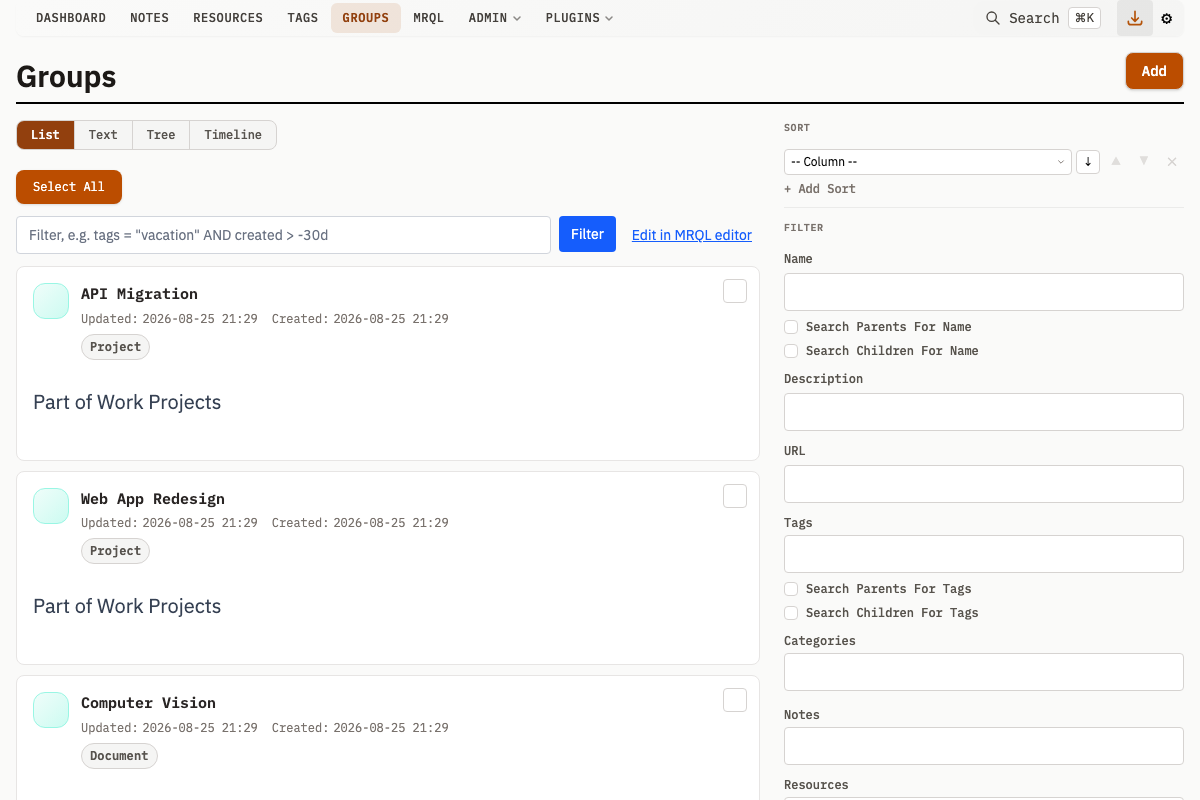
Group Properties
| Property | Type | Description |
|---|---|---|
name | string | Display name (required, non-empty) |
description | string | Free-text description |
url | URL | Optional external URL |
meta | JSON | Arbitrary key-value metadata (defaults to {}) |
ownerId | integer | FK to parent Group |
categoryId | integer | FK to Category for typing |
createdAt | datetime | Creation timestamp |
updatedAt | datetime | Last update timestamp |
Group descriptions support @-mentions. Type @ to search and link to resources, notes, other groups, and tags. For groups, removing a resource or note mention from the description removes that relation on save (unlike notes, where mentions are additive only). Tag and group mentions are always additive. See Mentions.
Hierarchical Organization
Groups form a tree through ownership:
Company (Group)
+-- Engineering (Group) [owned]
|   +-- Backend Team (Group) [owned]
|   +-- Frontend Team (Group) [owned]
+-- Marketing (Group) [owned]
+-- Sales (Group) [owned]
Ownership Rules
- Each Group can have one owner (parent)
- Root Groups have no owner
- Deleting a parent Group sets
ownerIdto NULL on all owned entities (child Groups, Notes, and Resources are preserved as unowned) - Deleting a Group also deletes every typed Relation in which it is either endpoint, whatever the far endpoint is, and removes its id from any note
referencesblock
Ancestor Chain
The GET /v1/group/parents endpoint resolves the full parent chain (recursive CTE, max depth 20). The UI uses this for breadcrumb navigation.
Group Tree
The GET /v1/group/tree/children endpoint returns child Groups with counts, supporting lazy-loaded tree views. Parameters: parentId (Group ID, 0 for roots), limit (default 50, max 100).
Owned vs Related Entities
| Connection | Cardinality | Deletion Behavior |
|---|---|---|
| Owned Groups | one-to-many | SET NULL (child Groups preserved as unowned) |
| Owned Notes | one-to-many | SET NULL (Notes preserved as unowned) |
| Owned Resources | one-to-many | SET NULL (Resources preserved as unowned) |
| Related Groups | many-to-many | Independent lifecycle |
| Related Notes | many-to-many | Independent lifecycle |
| Related Resources | many-to-many | Independent lifecycle |
| Typed Relations | one-to-many (both directions) | Deleted with the Group |
Categories
Categories define types of Groups with custom presentation. See Tags and Categories for details.
Categories support:
- Custom HTML template slots for the detail page, cards, hover cards, list pages and MRQL results, plus a
CustomCSSslot (see Custom Templates) - JSON Schema metadata validation via
metaSchema - Category-based filtering in queries
Deleting a Category sets categoryId to NULL on all Groups of that Category. The Groups are preserved, just uncategorized. Deletion also cascades to any RelationType constrained to that Category (as either fromCategoryId or toCategoryId): every such RelationType is deleted along with all of its Relations, and backRelationId pointers on other RelationTypes that referenced them are cleared.
Name Search
Group name search supports exact matching when the query is wrapped in double quotes:
GET /v1/groups?Name="Exact Group Name"
Without quotes, Name performs a LIKE (partial) match.
Cloning
POST /v1/group/clone creates a new Group with identical name, description, meta, URL, owner, and Category. It also copies all association references: related Resources, Notes, Groups, and Tags. Typed Relations are copied too, in both directions, so the clone participates in the same relations as the original; for a group-limited caller, relations whose far endpoint is outside the subtree are skipped.
Merging
POST /v1/groups/merge combines multiple Groups into one:
- All Tags from losers transfer to the winner
- Owned Groups, Notes, and Resources transfer to the winner
- Related entities link to the winner
- Typed Relations transfer to the winner
- Metadata merges (loser values added)
- Loser data is backed up in the winner's meta
- Loser Groups are deleted
Query Parameters
Filter Groups with these parameters on GET /v1/groups:
| Parameter | Type | Description |
|---|---|---|
Name | string | LIKE search (exact match with "quotes") |
Description | string | LIKE search |
OwnerId | integer | Filter by parent Group |
Tags | integer[] | Filter by Tag IDs (AND logic) |
Groups | integer[] | Filter by related Groups or parent |
Notes | integer[] | Filter by related/owned Notes |
Resources | integer[] | Filter by related/owned Resources |
Categories | integer[] | Filter by multiple Category IDs |
CategoryId | integer | Filter by single Category ID |
Ids | integer[] | Filter by specific Group IDs |
URL | string | LIKE search on URL |
CreatedBefore | string | Date upper bound |
CreatedAfter | string | Date lower bound |
UpdatedBefore | string | Update-date upper bound |
UpdatedAfter | string | Update-date lower bound |
MRQL | string | MRQL filter expression, as sent by the list-page filter bar |
RelationTypeId | integer | Filter Groups matching a Relation Type's category |
RelationSide | integer | 0 = from side, non-zero = to side |
SearchParentsForName | boolean | Also search parent Group names |
SearchChildrenForName | boolean | Also search child Group names |
SearchParentsForTags | boolean | Also check parent Group Tags |
SearchChildrenForTags | boolean | Also check child Group Tags |
MetaQuery | string[] | JSON meta queries (supports parent.key and child.key prefixes) |
SortBy | string[] | Sort columns (prefixed with groups., supports meta->>'key') |
MetaQuery Prefixes
Group MetaQuery supports special key prefixes:
parent.keyname-- searches the parent Group's metachild.keyname-- searches child Groups' meta
GET /v1/groups?MetaQuery=parent.status:active
Relationships
Ownership
- A Group can be owned by one parent Group
- Creates the hierarchical tree structure
Owned Entities
- A Group can own multiple Groups, Notes, and Resources
- Each entity type has different deletion behavior (see table above)
Related Entities
- Many-to-many connections to Groups, Notes, and Resources
- Independent lifecycles
Typed Relations
- Directed, typed connections between Groups via the Relations system
- See Relationships
Tags
- Many-to-many via
group_tags
Bulk Operations
| Endpoint | Description |
|---|---|
POST /v1/groups/addTags | Add Tags to multiple Groups |
POST /v1/groups/removeTags | Remove Tags from multiple Groups |
POST /v1/groups/addMeta | Merge metadata into multiple Groups |
POST /v1/groups/delete | Delete multiple Groups |
POST /v1/groups/merge | Merge Groups into one |
API Operations
For full API details, see API: Groups.